Remembering Herb Ziegeldorf: A Steadfast Champion for Tenants’ Rights

Written by John Bartlett, Former Executive Director of Metropolitan Tenant Organization

It is difficult to imagine MTO without Herb Ziegeldorf.

A longtime supporter, dedicated board member, and unwavering advocate, Herb passed away on Christmas, leaving behind a legacy woven deeply into the fabric of our organization.

When we say Herb was always there for MTO, we truly mean it. He stood with us from the very beginning, when the Tenant Bill of Rights was still only an idea.

I first met Herb during his work as an accessibility advocate with HUD, and even then, his commitment to equity and inclusion was unmistakable.

Thanks to his leadership, accessibility became a core pillar of MTO’s mission. He played a key role in expanding our mission statement to include the right to safe, decent, and accessible housing, and he pushed us to champion the addition of Source of Income protections to the Cook County Human Rights Ordinance.

As a board member, Herb’s impact was felt in countless ways—many of them quiet, unglamorous, and absolutely essential. He helped guide MTO through two office moves, ensuring each space remained accessible to all. He took on the tasks that few others volunteered for: revising bylaws, serving as treasurer, overseeing audits and budgets.

As our parliamentarian, he kept us grounded in democratic decision-making and reminded us of the values we stand for.

Even after term limits required him to step down from the board, Herb never stepped away from MTO. He continued to check in regularly, offering support, encouragement, and a willingness to help however he could.

Herb’s presence, leadership, and kindness shaped MTO in profound ways. We will miss him deeply, and we honor the legacy he leaves behind.

Tenant Wins – Power Restored in More Ways Than One

Empowerment often begins with knowledge. Earlier this year, on the MTO hotline, MTO spoke with a man from Chicago’s Pullman neighborhood. He is a disabled veteran living on a limited income. For three years, he had been paying more than $200 a month to ComEd and could not understand why his bill was so high. Eventually, the cost became unmanageable, and his power was shut off.

When the electricity was disconnected, his neighbors also lost power in parts of their apartments and in the hallway. It became clear that he had been unfairly paying for electricity that served other units.

Through our conversation, he learned what his rights are and what steps he could take. He decided to write a letter to the property owner stating that:

  • The owner is responsible for all charges beyond his actual usage,
  • He is seeking compensation for the overpayments, and
  • The landlord must place the utility account in their own name until the issue is resolved.

At the end of the call, he said, “Now I have a plan I can implement.” That moment

When someone realizes they have options and a path forward is empowerment.

From Crisis to Compensation: Organizing Works!

In May 2025, our team responded to an urgent call from a tenant who had just received a devastating notice: their building had been declared uninhabitable by the Department of Buildings, and all residents were required to vacate within two days.



MTO mobilized immediately. That same day, MTO Building Organizer, David Wilson, went on-site to meet with tenants, explain their rights, and walk them through what to expect when a building is shut down due to landlord negligence. By Wednesday, the situation had escalated, and Chicago police and a court-appointed receiver arrived to clear the building, using methods that felt coercive and dehumanizing, with tenants treated more like criminals than residents.

Despite the urgency and uncertainty, MTO, in partnership with Law Center for Better Housing (LCBH), remained on the ground, working closely with the Department of Family and Support Services (DFSS) and the Red Cross to secure emergency shelter for displaced residents. At the same time, staff began advocating for tenants to receive compensation for the hardship they were facing.

Out of the 72-unit building, we were able to connect directly with 22 tenants. Many others had already left, unwilling to endure the deteriorating conditions.

MTO and LCBH negotiated with the receiver, who initially offered tenants between $650 and $800 in compensation. Recognizing that this was insufficient given the circumstances, our team pushed back. Through persistent advocacy and negotiation, we secured a revised offer of $2,000 per tenant, an outcome that tenants felt was far more fair.

This case is a powerful example of how rapid response, community collaboration, and organizing can make a meaningful difference.

Celebrating 40 Years of Tenant Power

In February, we celebrated MTO’s 40th anniversary by bringing together all past leaders who made MTO the organization it is today. Together, we also celebrated John Bartlett’s retirement and his decades of advocacy and guidance. Thank you to everyone who joined us in celebrating the power of community!

The Next 40 Years of Housing Advocacy Starts Now!

RELEASE: Chicago City Council Passes Ordinance Establishing​ Proactive Rental Inspection Working Group

Chicago Healthy Homes Coalition LogoWe are proud to have been part of the Chicago Healthy Homes Coalition’s work to pass this Working Group Ordinance. We look forward to further organizing and collaborating to ensure that Chicago renters/tenants have safe, secure housing. Along with the City of Chicago’s efforts to establish a rental registry, this demonstrates that housing is increasingly seen as a human right.

You can find more details via this Block Club Chicago article

Loader Loading...
EAD Logo Taking too long?

Reload Reload document
| Open Open in new tab

Click Here to Download [102.26 KB]


Tenants Union in Uptown Wins $40,000 from Corporate Landlord!

After years of affordable rents under a small independent landlord, tenants at the corner of W. Montrose and N. Dayton received a horrifying holiday surprise. Right after Christmas, tenants received a notice from Rockwell Property (representing the building’s new ownership group, Montrose Investment Partners II LLC) that they had approximately 120 days to vacate their homes so their new landlord could renovate the building.

Many tenants had lived in the building for decades. Rockwell Property offered tenants a paltry $500 on the way out and a $500 credit if they moved back into the building when the renovations were done, and rents would inevitably be unaffordable for most tenants.

Fearful that they would not be able to afford to move and angry that they could be displaced so suddenly, the tenants sprang into action and formed the Mon-Day Tenants Association (MDTA) with one simple demand: if you want us to move, pay us to do so!

The demand was far from unreasonable. If the proposed Just Cause for Eviction Ordinance were law in Chicago, the landlord would have to give tenants, displaced through no fault of their own, substantial relocation assistance.

For the first month of the campaign, building ownership refused to negotiate with the MDTA. But with the help of organizers from MTO and ONE Northside, the MDTA gathered community support, escalated public pressure, and forced the owners to the table.

After weeks of intense negotiations, the MDTA approved an agreement in which the landlord waived last month’s rent and gave each unit $2,000 upon return of their keys at move-out.

MTO is proud to congratulate the MDTA on its victory. Organizing works!


Breathing Room: MTO Helps a Family Escape Unsafe Housing

Toxic Air in Residential Apartment

Mr. Thomas came through MTO’s doors as a walk-in. He was desperate for help because his apartment was constantly filled with smoke, debris, and other fumes. Despite his repeated pleas to fix the problem, his landlord had done nothing. Mr. Thomas’s seven-year-old son suffers from bronchial asthma. His unit’s noxious air exacerbated his son’s asthma, repeatedly landing him in the hospital emergency room. Mr. Thomas tried to work out a solution and even offered to pay money to the owner to let him out of his lease, but the owner denied his requests.

MTO’s Staff Attorney intervened on his behalf.

After some back and forth, the property owner learned about the potential legal consequences. As a result, they negotiated an agreement that allowed Mr. Thomas to move and receive needed relocation assistance. Now, Mr. Thomas and his son are living in a safe, healthy apartment without the threat of eviction or collections hanging over their heads.

“Just Cause” Ordinance Introduced in City Council

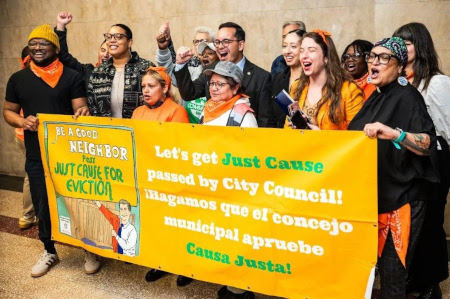
Just Cause Ordinance Coalition On Wednesday, May 21, numerous supporters descended on Chicago’s City Council Meeting to support the introduction of the Just Cause Eviction Ordinance. The law requires landlords to have a just cause to evict a tenant. It would ban evictions due to retaliation. MTO supports passage of the just cause ordinance as a means of balancing power between landlords and tenants. If Just Cause passes, it would mean landlords would no longer have the power to threaten tenants with eviction for requesting repairs or organizing.

Under the proposed law, landlords must state one of seven reasons why they are evicting a tenant. Reasons include: failure to pay rent, follow the lease rules, refusal to sign a lease, the landlord wishes to no longer rent the unit or rent it to a relative, major rehab of the unit, or convert it to condominiums. If the landlord is terminating the lease for a reason in which the tenant is not at fault, then the tenant would be entitled to relocation assistance. So while the law does not end gentrification, it does begin to move the costs of gentrification to the property owners and developers, as they are the ones who benefit. Finally, the bill would create a registry of landlords and require people who own more than 20% of the building to disclose their interest.

Upon introduction, Alderman Ray Lopez asked that the bill be sent to the rules committee. His goal is to try and bury the tenants’ rights legislation. The Chicago Housing Justice Coalition is working with Council member Desmon Yancy to get the bill out of rules and into the housing committee for a hearing.