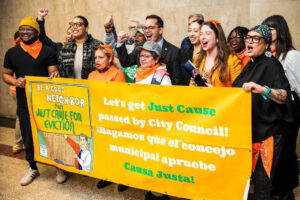
RELEASE: Chicago City Council Passes Ordinance Establishing​ Proactive Rental Inspection Working Group

Chicago Healthy Homes Coalition LogoWe are proud to have been part of the Chicago Healthy Homes Coalition’s work to pass this Working Group Ordinance. We look forward to further organizing and collaborating to ensure that Chicago renters/tenants have safe, secure housing. Along with the City of Chicago’s efforts to establish a rental registry, this demonstrates that housing is increasingly seen as a human right.

You can find more details via this Block Club Chicago article

Loader Loading...
EAD Logo Taking too long?

Reload Reload document
| Open Open in new tab

Click Here to Download [102.26 KB]


Breathing Room: MTO Helps a Family Escape Unsafe Housing

Toxic Air in Residential Apartment

Mr. Thomas came through MTO’s doors as a walk-in. He was desperate for help because his apartment was constantly filled with smoke, debris, and other fumes. Despite his repeated pleas to fix the problem, his landlord had done nothing. Mr. Thomas’s seven-year-old son suffers from bronchial asthma. His unit’s noxious air exacerbated his son’s asthma, repeatedly landing him in the hospital emergency room. Mr. Thomas tried to work out a solution and even offered to pay money to the owner to let him out of his lease, but the owner denied his requests.

MTO’s Staff Attorney intervened on his behalf.

After some back and forth, the property owner learned about the potential legal consequences. As a result, they negotiated an agreement that allowed Mr. Thomas to move and receive needed relocation assistance. Now, Mr. Thomas and his son are living in a safe, healthy apartment without the threat of eviction or collections hanging over their heads.

“Just Cause” Ordinance Introduced in City Council

Just Cause Ordinance Coalition On Wednesday, May 21, numerous supporters descended on Chicago’s City Council Meeting to support the introduction of the Just Cause Eviction Ordinance. The law requires landlords to have a just cause to evict a tenant. It would ban evictions due to retaliation. MTO supports passage of the just cause ordinance as a means of balancing power between landlords and tenants. If Just Cause passes, it would mean landlords would no longer have the power to threaten tenants with eviction for requesting repairs or organizing.

Under the proposed law, landlords must state one of seven reasons why they are evicting a tenant. Reasons include: failure to pay rent, follow the lease rules, refusal to sign a lease, the landlord wishes to no longer rent the unit or rent it to a relative, major rehab of the unit, or convert it to condominiums. If the landlord is terminating the lease for a reason in which the tenant is not at fault, then the tenant would be entitled to relocation assistance. So while the law does not end gentrification, it does begin to move the costs of gentrification to the property owners and developers, as they are the ones who benefit. Finally, the bill would create a registry of landlords and require people who own more than 20% of the building to disclose their interest.

Upon introduction, Alderman Ray Lopez asked that the bill be sent to the rules committee. His goal is to try and bury the tenants’ rights legislation. The Chicago Housing Justice Coalition is working with Council member Desmon Yancy to get the bill out of rules and into the housing committee for a hearing.


Advocating Using the Residential Landlord and Tenant Ordinance (RLTO)


When Naeema moved into her new apartment, she was excited and thinking about the future in her new home. Within the first month, problems began appearing: the toilet would not flush, water pressure was not enough for a proper shower, and roaches scuttled across her floors.

Despite multiple attempts to get her property manager to address these problems, her concerns went unanswered, leaving her feeling stuck and frustrated. That is when Naeema reached out to MTO for help. After listening to her concerns, hotline counselors explained her rights under the Residential Landlord and Tenant Ordinance (RLTO), including her remedies for dealing with a neglectful landlord and her right to complain to Chicago’s Department of Buildings for an inspection.

With this information, Naeema felt empowered to act. Together, we helped her draft a letter to the management company detailing the issues and her rights as a tenant. The results were immediate.

Management agreed to let Naeema out of her lease without penalty and offered to refund her first month’s rent and move-in fee. Following this breakthrough, Naeema conducted a walkthrough of the apartment with the property manager. The unit was in the same condition as when she moved in, and the manager confirmed the refund and lease termination. Within that same week, Naeema picked up her refund check, covering her first month’s rent and move-in fees in full. She then moved out, leaving behind the stressful conditions and regaining peace of mind. Naeema’s persistence, combined with the right support and knowledge of her tenant rights, turned a demanding situation into a positive resolution. Now, she is ready for a fresh start in a home that meets her needs.

SRO Preservation Ordinance

ORDINANCE

WHEREAS, The City of Chicago is a home-rule unit of government under Article Vll, Section 6(a) of the 1970 Constitution of the State of Illinois, and, as such, may exercise any power and perform any function pertaining to its government and affairs; and

WHEREAS, The City’s home-rule authority includes the power to enact ordinances and regulations aimed at preserving safe, decent, and affordable housing in Chicago; and

WHEREAS, The City Council has determined that single-room occupancy buildings (SROs) and residential hotels are an essential component of the City’s affordable housing stock, and that these forms of housing are increasingly scarce due to sale and other market forces; and

WHEREAS, The loss of these effectively irreplaceable forms of affordable housing will likely force low-income households into homelessness, a dire outcome that will add to the already crushing burden on public and non-profit agencies that provide the homeless with protective care, social services, health care, psychological counseling, nutritional programs, and other necessary support; and

WHEREAS, For these reasons, the City has a vital interest in maintaining existing affordable housing by discouraging the conversion and demolition of SROs and residential hotels; and

WHEREAS, The City therefore expresses a firm commitment to make resources available, between now and the end of the year 2018, to preserve no less than 700 units of affordable housing for very and extremely low-income Chicagoans, including SRO and residential hotel units, by implementing an aggressive strategy centered on encouraging owners to participate in a variety of incentive programs or to cooperate in the efforts of preservation buyers to acquire such properties; and

WHEREAS, In addition to this commitment on its own behalf, the City recognizes the need to enact new legal requirements tailored to preserve and protect Chicago’s existing SROs and residential hotels; now, therefore,

BE IT ORDAINED BY THE CITY COUNCIL OF THE CITY OF CHICAGO: SECTION

1. The recitals set forth above are incorporated herein by reference and made a part hereof. SECTION

2. Title 5 of the Municipal Code of Chicago is hereby amended by adding a new chapter 5-15, as follows:

CHAPTER 5-15

SINGLE-ROOM OCCUPANCY AND RESIDENTIAL HOTEL PRESERVATION ORDINANCE

5-15-010 Title and purpose.

This chapter shall be known and may be cited as the “Single-Room Occupancy and Residential Hotel Preservation Ordinance,” and shall be liberally construed and applied to achieve its purpose, which is to promote the public welfare by preserving single-room occupancy buildings and residential hotels, thereby sustaining the availability of affordable housing in neighborhoods throughout Chicago. The legislative intent of this chapter is to advance the City’s vital interests in reducing homelessness and maintaining an economically diverse population.

5-15-020 Definitions.

For purposes of this chapter, the following definitions apply:

“Affordable housing” means housing where the residents pay no more than 30% of their adjusted gross monthly household income in rent.

“Commitment Option A.” “Commitment Option B.” and “Commitment Option C” mean the preservation fee calculation mechanisms set forth in Sections 5-15-040 and 5-15-050.

“Conversion” means any action that transforms all or part of a covered property into any type of use, residential or non-residential, that does not fall into the category of covered property.

“Covered property” means any single-room occupancy building, single-room occupancy unit, residential hotel, or residential hotel unit, as well as the land upon which any single-room occupancy building or residential hotel sits, in the City of Chicago.

“Demolition” means any action resulting in the complete or partial, interior or exterior, destruction of a covered property, or the combination of two or more units in a covered property to make a larger unit, or any other action that results in the reduction of the number of units in a covered property.

“Extremely low-income” means those individuals and families whose gross household incomes are between 0 and 30 percent of the median gross household income for the Chicago region, as determined by the Secretary ofthe United States Department of Housing and Urban Development, with adjustments for smaller and larger families.

“Owner” has the meaning ascribed to that term in Section 13-4-010 of the Municipal Code of Chicago.

“Residential hotel” means any building or structure kept, used, maintained, or advertised or held out to the public, as of September 10. 2014. to be an inn, hotel, motel, family hotel, apartment hotel, lodging house, or other place where furnished sleeping or rooming accommodations are made available for hire or rent, with or without meals, and in which seven or more sleeping rooms are used or maintained for the primary residence of guests, lodgers, or roomers who reside in the property for at least 32 consecutive days, and pay rent to the owner.The term “residential hotel” does not include any hospital, convent, monastery, extended care facility, asylum, not-for-profit home for the aged, temporary overnight shelter, transitional shelter or residence, domestic violence shelter or residence, community home, or dormitory owned and operated by an elementary school, high school, or institution of higher learning. For purposes of this definition, a person is not a guest, lodger, or roomer if his or her employer pays, directly or through reimbursement, the costs of his or her lodging.

“Residential hotel unit” means a room within a residential hotel used as, or intended to be used as. a living space by guests, lodgers, or roomers who reside in the property.

“Single-room occupancy building” and “single-room occupancy unit” have the meanings ascribed to those terms in Section 13-4-010 of the Municipal Code of Chicago.

“Subsidized affordable housing” means affordable housing where individuals and families reside and pay rent to the owner with the benefit of governmental or charitable rental subsidies, rental assistance payments, or other housing assistance payment contracts, which may create a third-party right to the tenancy.

“Unsubsidized affordable housing” means affordable housing where individuals and families reside and pay rent to the owner without the benefit of any governmental or charitable rental subsidies, rental assistance payments, or other housing assistance payment contracts.

“Very low-income” means those individuals and families whose gross household incomes are between 30 and 50 percent of the median gross household income for the Chicago region, as determined by the Secretary of the United States Department of Housing and Urban Development, with adjustments for smaller and larger families.

5-15-030 Preservation fees.

The amount of any preservation fee remitted pursuant to this chapter shall be calculated by the commissioner of planning and development, and the funds shall be utilized for the development, improvement, and preservation of single-room occupancy buildings and residential hotels. The amount of such fees shall be adjusted annually based upon the United States Department of Labor, Bureau of Labor Statistics’s Consumer Price Index for all Urban Consumers for the Chicago metropolitan area, or, if this index no longer exists, some other comparable index, selected by the commissioner of planning and development in his reasonable discretion. The City shall establish and promote a process for owners and purchasers of covered properties to apply for financial incentives in exchange for entering into binding land-use agreements to preserve the properties as single-room occupancy buildings and residential hotels.

5-15-040 Conversion or demolition of covered properties – prerequisites.

The department of buildings shall not process any permit allowing the conversion or demolition of a covered property. or any new development on the site of a demolished covered property. until the property’s owner has filed, and the commissioner of buildings granted, an application for clearance. The commissioner of buildings shall prescribe the form of this application, and shall not grant an application unless the owner meets the requirements described in either subsection 5-15-040(a) or subsection 5-15-040(b).

(a) In lieu of proceeding pursuant to subsection 5-15-040(b). the owner shall enter into a binding land-use agreement with the City: (1) providing that the proposed project will create and/or retain at the property a number of units equal to a percentage of the number of units in the existing property as subsidized or unsubsidized affordable housing for very and extremely low-income individuals and families; and (2) agreeing to maintain those units as subsidized or unsubsidized affordable housing for very and extremely low-income individuals and families for a period of not less than 20 years. If the committed percentage is less than 20%. the owner shall also remit to the City a preservation fee in the amount of 20% of the units minus the committed percentage of units times $200.000 (as adjusted pursuant to Section 5-15- 030). For example, if the owner of a 100-unit building commits a number of units equal to 15% of the property’s units, he shall remit to the City a preservation fee in the amount of $1,000.000: 20% of 100 (i.e.. 20) minus 15% of 100 (i.e.. 15) equals five: five times $200,000 equals $1,000,000. For purposes of this chapter, this option shall be referred to as “Commitment Option A.”

(b) In lieu of proceeding pursuant to subsection 5-15-040(a). the owner shall remit to the City a preservation fee in the amount of 20% of the number of units in the existing property times $200.000 (as adjusted pursuant to Section 5-15-030). For example, if the owner of a 100- unit building proceeds under this subsection 5-15-040(b). he shall remit to the City a preservation fee in the amount of $4.000.000: 20% of 100 (i.e., 20) times $200,000 equals $4,000.000. For purposes of this chapter, this option shall be referred to as “Commitment Option B.”

5-15-050 Sale or transfer of covered properties – prerequisites.

Before selling or otherwise transferring ownership of a covered property. the owner shall meet the requirements described in either subsection 5-15-050(a) or subsection 5-15-050(b).

(a) (1) The owner may choose to:

(A) provide to the department of planning and development by first class mail, and to the residents of the property by hand delivery and first class mail, at least 180 days’ notice of the proposed sale or transfer of the property:

(B) allow the property’s residents or any representative of the residents 180 days following the date of notice to tender an offer to purchase the property: and

(C) upon receiving any such offer, engage in good-faith negotiations, during the remaining portion of the 180-day period described in subsection 5-15-050(a)(1)(B), towards a purchase and sale agreement with the offering party. 

(2) If the owner accepts an offer tendered and negotiated in the manner described in subsection 5-15-050(a)(1). then the owner shall include in the contract for sale or transfer a clause whereby the purchaser agrees to maintain, for a period of not less than 20 years, a number of units equal to at least 33% of the current number of units at the property as subsidized or unsubsidized affordable housing for very and extremely low-income individuals and families.

(3) If the owner receives an offer and meets the requirement of negotiating in good faith, as described in subsections 5-15-050(a)(1)(B) and (C), but does not reach a purchase and sale agreement with the offering party, then the owner shall be allowed a period of 60 days following the end of the 180-notice period described in subsection 5-15-050(a)(1)(A) within which to sell or transfer the property to any other party. If an owner sells or transfers a property pursuant to this subsection 5-15-050(a)(3). he shall include in the contract for sale or transfer a clause whereby the purchaser agrees to comply with either Commitment Option A or Commitment Option B. Beginning on the 61st day following the end of the 180-day notice period described in subsection 5-15-050(a)(1)(A). the owner shall not sell the property without either repeating the process described in subsection 5-15-050(a)(1) or meeting the requirements in subsection 5-15-050(b).

(b) In lieu of proceeding pursuant to subsection 5-15-050(a), the owner may opt out of the right-to-purchase process described in that subsection by remitting to the City a preservation fee in the amount of 30% of the number of units in the property times $200.000 (as adjusted pursuant to Section 5-15-030). For example, if the owner of a 100-unit building proceeds under this subsection 5-15-050(b). he shall remit to the City a preservation fee in the amount of $6,000,000: 30% of 100 (i.e., 30) times $200.000 equals $6.000.000. For purposes of this chapter, this option shall be referred to as “Commitment Option C.”

5-15-060 Anti-displacement and relocation requirements.

(a) Each resident of a covered property scheduled to be demolished, converted, or sold or otherwise transferred, who has resided in the property for at least 31 consecutive days preceding the date the owner initiates any of the processes described in Sections 5-15-040 and 5-15-050, shall be considered a long-term resident. Each owner of a covered property who undertakes any of the processes described in Sections 5-15-040 and 5-15-050 in a manner that will result in the displacement of residents shall submit a list of all long-term residents to the commissioner of planning and development and, where applicable, to the purchaser of the property.

(b) In situations where a covered property is scheduled to be converted, demolished and replaced, or sold or otherwise transferred in a manner that results in the displacement of residents, the owner or purchaser, as applicable, shall determine which, if any, of the current income-eligible and lease-compliant long-term residents wish to return to the property. If the number of affordable units scheduled to be retained is less than the number of long-term residents wishing to return, then the owner or purchaser, as applicable, shall determine via lottery which of those residents to invite to return to the property.

(1) In situations where conversion or construction renders the property temporarily uninhabitable, the owner shall arrange for comparable temporary accommodations, as defined by the commissioner of planning and development, for each resident who is invited and intends to return to the property. as well as all reasonable moving and related expenses, not to exceed one month’s rent (or the amount of rent the resident has paid over the most recent 30 days, if rent is not paid on a monthly basis).

(2) In all cases under this subsection 5-15-060(b). the owner or purchaser, as applicable, shall refund to each resident who is not invited to return to the property any security deposit, any interest due on the security deposit, and all prepaid rent. In addition, the owner or purchaser as applicable, shall pay each displaced long-term resident a one-time relocation assistance fee in the amount of the greater of $2.000.00 or three months’ rent (or three times the amount of rent the resident has paid over the most recent 30 days, if rent is not paid on a monthly basis). The owner or purchaser, as applicable, shall also give each displaced long-term resident the option of placement on a waitlist for an affordable housing unit in the property.

(c) In situations where a covered property is scheduled to be sold or otherwise transferred pursuant to the terms described in subsection 5-15-050(b), the owner shall refund each resident’s security deposit, any interest due on the security deposit, and all prepaid rent, and shall pay each long-term resident a one-time relocation assistance fee in the amount of $10.600.00.

5-15-070 Change in terms of rental, lease, or occupancy agreements.

The owner of a covered property shall hand deliver to each resident written notice of any change in the terms of that resident’s rental, lease, or occupancy agreement, including changes in the frequency or amount of payment for rent, occupancy. or other housing purposes. The timinq of this notice shall be determined by the resident’s existinq rental, lease, or occupancv aqreement. whether written or oral. For example, if a resident pays rent on a weekly basis, he is entitled to one week’s notice pursuant to this section. A rent increase imposed in compliance with this section shall not constitute retaliatory conduct as contemplated in Section 5-12-150 of this Code, so lonq as the increase is imposed on a property-wide basis.

5-15-080 Provision of room keys to residents.

The owner of a covered propertv shall provide each resident a copy of the key to his room. If an owner violates this section, the affected resident shall be entitled to $2.000.00 or twice the monetary value of the damaqes sustained, whichever is qreater

5-15-090 Enforcement.

(a) Any resident of a covered property who is injured by a violation of this chapter may institute injunctive, mandamus, or any other appropriate legal action seeking enforcement. A resident who institutes a leqal action pursuant to this chapter and is adiudqed to be a prevailinq partv mav be awarded attorney’s fees and court costs.

(b) If the City initiates or joins any enforcement action against an owner who violates or resists enforcement of this chapter, the owner shall be fined not less than $200.00 nor more than $500.00 for each offense upon which a finding of liability is entered. Each day a violation continues shall constitute a separate offense.

(c) If the owner of a covered property sells the property before remitting to the City a preservation fee required under this chapter, both the owner and purchaser shall be jointly and severely liable for the payment of such fee.

SECTION 3. This ordinance shall take effect 10 days after its passage and publication.

Keep Chicago Renting Ordinance (KCRO)

What is the Keep Chicago Renting Ordinance? 

The City of Chicago enacted the Protecting Tenants in Foreclosed Rental Property Ordinance, commonly known as the Keep Chicago Renting Ordinance (KCRO), in response to the harmful effect of the mortgage foreclosure crisis on renters in Chicago. The ordinance aims to keep renters in their homes by requiring new building owners to offer bonafide tenants a lease renewal or $10,600 in relocation assistance. You can view the full text of the ordinance by scrolling down or clicking here.

The KCRO Requires New Owners to Serve Tenants with Written Notice of Change in Ownership    Notice of change in ownership must be provided within 21 days after a person becomes an owner or within 7 days of determining the tenant’s identity. Notice must be delivered to known tenant or household member 13 years or older or mailed. In addition, notice must be posted on the primary entrance of each foreclosed property . Chicago Municipal Code, § 5-14-040(a),(b)

The Ordinance requires that the notice be given in English, Spanish, Polish and Chinese. The Lawyers’ Committee for Better Housing (LCBH) has translated the notice and those translations may be used by owners to inform their tenants in accordance with the law. The notices can be downloaded by clicking here.

The KCRO Requires Notice Before the Owner Can Collect Rent
Until the owner serves notice under § 5-14-040, the owner cannot collect rent or terminate a tenant’s lease for failure to pay rent. Chicago Municipal Code, § 5-14-040(c).

The KCRO Requires Owners to Renew or Extend Leases or Pay Substantial Relocation Assistance
The Ordinance requires the owner of a foreclosed rental property to either:

  1. offer the Qualified Tenant a renewal or extension of their lease with a rent increase of no more than 2%; or
  2. pay the tenants a relocation fee of $10,600 within seven days of the Qualified Tenant vacating the unit. Chicago Municipal Code, § 5-14-050(a).

If the owner elects to offer a lease, the owner must continue to offer renewals or extensions (with rent increases of no more than 2% per year) until the owner sells the property to a “bona fide third-party purchaser.” Chicago Municipal Code, § 5-14-050(g).

What Tenants Are Entitled to Protections Under the Ordinance?
The Ordinance protects “Qualified” tenants who have a bona fide (valid) lease or rental agreement. The definition of a bona fide lease or rental agreement includes all agreements, whether written or oral, as long as:

  • The tenant is not the mortgagor, or the child, spouse, or parent of the mortgagor;
  • The lease or tenancy was the product of an arm’s-length transaction; and
  • The rent required under the lease or tenancy is not substantially less than fair market or is subsidized by the government. Chicago Municipal Code, § 5-14-020.

In other words, leases entered into with children, parents, or the spouse of the former owner; leases where both parties did not negotiate in their own best interest; and leases with substantially less than fair market rent are not considered bona fide, and tenants without bona fide leases are not qualified tenants under the Ordinance.

Which Property Owners Are Subject to the Ordinance?

  1. any person who acquires ownership of a property pursuant to a judicial sale of a foreclosed rental property, after the sale has been confirmed by the court and any special right of redemption has expired; or
  2. mortgagees that acquire ownership of a property through foreclosure or a deed in lieu of foreclosure. Chicago Municipal Code, § 5-14-020.

Which Property Owners Are Not Subject to the Ordinance?

  1. an owner of a foreclosed rental property who was the owner prior to the effective date of the Ordinance;
  2. a person appointed as a receiver and issued or assigned, a Receiver’s Certificate; or
  3. a bona fide not-for-profit in existence continuously for a period of five years immediately prior to becoming the owner of the rental unit and whose purpose is to provide financing for the purchase or rehabilitation of affordable housing. Chicago Municipal Code, § 5-14-030.

Penalties
If an owner fails to comply with § 5-14-050 (Tenant relocation assistance), the qualified tenant shall be awarded damages in an amount equal to two times the relocation assistance fee. Chicago Municipal Code, § 5-14-050(f). Penalties for violation of the KCRO are significant enough that LCBH expects substantial compliance.

NEED ASSISTANCE? Call the LCBH’s free Tenants in Foreclosure Help Line: 312-784-3507 or call our free Tenants Rights Hotline, Monday-Friday between 1:00pm – 5:00pm: 773-292-4988.

To find out if your building is in foreclosure, click here and follow the step-by-step instructions.

——————————————————————————————-

The “Keep Chicago Renting” Ordinance

Section 1. Title, Purpose and Scope.

This chapter shall be known and may be cited as the “Keep Chicago Renting” ordinance and shall be liberally construed and applied to promote its purposes and policies. It is the purpose of this ordinance, in order to protect, maintain, and improve foreclosed rental property, preserve rental housing stock, mitigate losses to area property values, and avoid neighborhood destabilization due to foreclosure, to prevent vacant foreclosed residential buildings and preserve tenancies in these properties. Except when this ordinance conflicts with the statutory or regulatory provisions governing federal housing subsidy programs, including, but not limited to, public housing and project-based Section 8 housing operating pursuant to 42 U.S.C. § 1437 et seq., the provisions of this ordinance shall apply to and regulate ei;er3′ foreclosed property in which occupants hold possession of dwelling units. The rights, obligations and remedies established by this ordinance shall be cumulative and in addition to any others available at law or in equity. Nothing in this ordinance shall affect a landlord’s obligation to provide notice of termination of tenancy as required under applicable laws governing actions for possession.

Section 2. Definitions.

Whenever used in this ordinance, the following words and phrases shall have the following meaning:

(a) “Dwelling unit” means a structure or the part of a structure used as a home, residence or sleeping place by one or more persons who maintain a household, together with the common areas, land and appurtenant buildings thereto, and all housing services, privileges, furnishings and facilities supplied in connection with the use or occupancy thereof, including garage and parking facilities; except that this ordinance shall not govern dwelling units described in Subsections 5-12-020 (b) and, (c) of this Code.

(b) “Foreclosed property” means any property for which legal and equitable interests in real estate were terminated by a foreclosure action brought under the Illinois Mortgage Foreclosure Law (“IMFL”), 735 ILCS 5/15-1101 et seq.

(c) “Foreclosing owner” means a person or entity, or an agent acting on behalf of a person or entity that holds title in any capacity, directly or indirectly, to a foreclosed property and either (1) was a mortgagee who was a party to the foreclosure or is the subsidiary, parent, trustee, nominee or agent; or (2) is the Federal National Mortgage Association or the Federal Home Loan Mortgage Corporation.

(d) “Occupant” means any person in lawful physical possession of a dwelling unit in all or part of a foreclosed property and as described under Sections 1223 and 1508.5 ofthe IMFL.

(e) “Tenant” means a person entitled by written or oral agreement, subtenancy approved by the landlord or by sufferance to occupy a dwelling unit to the exclusion of others, as defined by the Chicago Residential Landlord Tenant Ordinance (“RLTO”) in Section 5-12-030 of this Code.

(f) “Bona fide third party purchaser” means a person or entity that is not a foreclosing owner and purchases the foreclosed property from the
foreclosing owner.

Section 3. Eviction of Occupants Prevented; Exceptions.

A foreclosing owner may not maintain an action for possession, except in accordance with this ordinance or unless a binding purchase and sale agreement has been executed and is in effect for the purchase of the dwelling unit by a bona fide third party purchaser.

Section 4. Notice Requirements.

Within 21 days of taking title to foreclosed property, a foreclosing owner must notify in writing all occupants of dwelling units of the real estate using the text provided in subsection (d) of this section. This notice must be printed in English and Spanish in no less than 14 point type, on paper at least eight and one-half inches by 11 inches in size.

(a) Service requirements shall be satisfied i f the foreclosing owner has (i) posted this notice in a prominent location in the building; (ii) mailed this notice by first class mail to each unit; and (iii) has made an attempt to personally serve an occupant of each unit in the building.

(b) The Commissioner of the Department of Housing and Economic Development (DHED) shall make available for distribution, both in print and in an easily printable format on the department’s Internet website, the following notice in English with a Spanish translation that may be used to satisfy the notice requirements of this section.

(c) Compliance and Curing Noncompliance. For purposes of collecting rent or maintaining an action for possession as described in Section 5, a foreclosing owner may cure a failure to timely provide notice by providing the notice more than 21 days after the transfer of title. Curing the notice deficiency, however, shall not waive any occupant’s right to remedies as described in Section 8 of this ordinance. Additionally, a foreclosing owner shall have no right to collect back rent that accrued during the period of time that the foreclosing owner was not in compliance with the notice requirements of this section.

(d) Text of Notice Provision:

IMPORTANT NOTICE TO OCCUPANTS

City of Chicago law requires that we provide you this notice informing you of your rights as occupants of [INSERT PROPERTY ADDRESS]. This property is now owned by [INSERT NAME OF FORECLOSING OWNER]. The former owner of this property no longer owns the property because the property was foreclosed. Chicago law protects your right to remain in your home after a foreclosure. [NAME OF ORDINANCE AND CITATION]. This law protects all occupants, even if you do not have a written lease. The law states that you cannot be evicted just because your building was foreclosed. You do not have to pay the new owner any rent owed before the due date provided in this notice. You can only be evicted if you do not pay rent starting on the due date provided in this notice, if you commit a crime or allow someone you know commit a crime in your home, if you damage your home, or if you refuse to let the new owner inspect your home and make necessary repairs. You can only be evicted after the new owner of this building files an eviction claim in court and you are given a chance to defend yourself in front of a judge. You can only be removed from your home by personnel of the Cook County Sheriffs office with an order from the court. Your rent cannot be raised unless the new owner of this building files in court and you have had a chance to defend your current rent in front of a judge. The former owner of this building has no right to collect rent since the former owner does not own the building anymore. You should now pay your rent to the new owner of this building: [INSERT NAME, ADDRESS, AND TELEPHONE CONTACT INFORMATION OF THE FORECLOSING OWNER, THE BUILDING MANAGER, OR OTHER REPRESENTATIVE OF THE FORECLOSURE OWNER RESPONSIBLE FOR COLLECTING RENT]. Please pay your rent on the [INSERT DAY] of each month by [INSERT METHOD OF TRANSMISSION]. You are not responsible for paying any back rent owed prior to the due date provided in this notice. The new owner of this building must maintain the property including making sure the building and your unit are safe and secure, removing trash and debris, and exterminating any vermin. The owner must also make sure that heat, running water, hot water, electricity, gas and plumbing services are all available. For maintenance issues and emergencies, please contact [INSERT NAME, ADDRESS, AND TELEPHONE CONTACT INFORMATION OF THE FORECLOSING OWNER, THE BUILDING MANAGER, OR OTHER REPRESENTATIVE OF THE FORECLOSURE OWNER RESPONSIBLE FOR COLLECTING RENT]. If you do choose to move, you are entitled to collect your security deposit from the new owner of this building. If the new owner of this building tries to evict you, raise your rent, refuses to return your security deposit, or fails to maintain your building, you may be eligible to collect damages. Please contact a lawyer, a legal aid or housing counseling agency, or the Coordinated Advice & Referral Program for Legal Services (CARPLS) legal aid hotline at (312) 738-9200 to discuss your rights.

Section 5. Right to Possession.

Except as described in Section 3, and except when state or federal law provides an occupant with additional or superior rights, a foreclosing owner shall have the right to maintain an action for possession of a dwelling unit against an occupant only after complying with the notice requirements of Section 4 and:

(a) thirty days have passed, an occupant has failed to pay rent, and the landlord has complied with all the applicable notice and cure periods governing eviction for nonpayment of rent, including, but not limited to, those provided by the RLTO and the Illinois Code of Civil Procedure, 735 ILCS 5/9-101 et seq. (“Forcible Entry and Detainer Act”) (hereinafter “FEDA”); or

(b) an occupant has failed to cure a breach of the lease agreement or other tenant responsibility as described in Section 5-12-040 of this Code and the landlord has complied with the applicable notice and cure periods governing eviction for breach of lease or tenant responsibilities, including, but not limited to, those provided by the RLTO and the FEDA; or

(c) an occupant violates Section 9-118, 9-119 or 9- 120 of the FEDA, and the landlord has complied with all other applicable notice and cure periods
required under these statutes; or

(d) thirty days have passed, an occupant’s bona fide lease or other rental agreement has terminated, and the foreclosing owner, by written request, has offered a lease under the same terms that were in effect at the time that the foreclosing owner took title, and the occupant has rejected that offer.

Section 6. Increase of Rent.

After complying with the notice requirements of Section 4, a foreclosing owner shall be entitled to recover rent. A foreclosing owner shall not charge an occupant of a dwelling unit a rental amount above that which the occupant had been paying for use and occupancy of the dwelling unit prior to foreclosure
without leave of court. The court may allow an increase of rent if, in an action brought by a foreclosing owner, the court finds by a preponderance of the evidence that the current rent is below market rate and an increase of rent is necessary to operate, manage, and conserve the dwelling unit. In the event that the foreclosing owner and an occupant of a dwelling unit agree to a rent increase for that dwelling unit, the foreclosing owner is excused from the requirements of this section as to that dwelling unit. Nothing in this section shall alter the terms of any lease agreement.

Section 7. Misrepresentation of Right to Possession.

It shall be unlawful for a foreclosing owner:

(a) to willfully or negligently misrepresent, by written or oral statement, the rights of the occupant or foreclosing owner regarding rightful possession of the dwelling unit;

(b) to withhold essential services, as defined under Subsection 5-12-110(f) of this Code, except that this ordinance shall also prohibit actions taken against occupants; or

(c) to interrupt occupancy as defined under Section 5-12-160 of this Code, except that this ordinance shall also prohibit actions taken against occupants.

Section 8. Defenses and Remedies.

If a foreclosing owner acts in violation of this ordinance, the occupant shall have a complete defense against the foreclosing owner in any action for possession. If an occupant in a civil legal proceeding establishes that a violation of this ordinance has occurred, the occupant shall be entitled to recover
$5,000.00 in damages or actual damages, whichever is greater, and reasonable attorney’s fees and costs. Each violation of this ordinance shall constitute a
separate offense.

For more information or assistance, contact our Foreclosure Organizer, Saul Garcia at 773-292-4988 ext 247 or at saul@tenants-rights.org

Chicago Bed Bug Ordinance

BE IT ORDAINED BY THE CITY COUNCIL OF THE CITY OF CHICAGO:

SECTION 1.

Section 2-112-160 of the Municipal Code of Chicago is hereby amended by inserting the language underscored and deleting the language struck through, as follows:

2-112-160 Commissioner – Enforcement powers and duties. The commissioner of health shall have the following powers and duties:

(a) Public health related powers and duties:

(1) To enforce all the laws of the state and provisions of this Code in relation to matters pertaining to the public health and sanitary conditions of the city;

(2) To enforce all regulations of the board of health or any other federal, state or local authority with power to make regulations concerning the public health;

(3) To cause all nuisances affecting the health of the public to be abated with all reasonable promptness;

(4) To determine when a disease is communicable or epidemic, and establish quarantine regulations whenever it is deemed necessary

(5) To enforce section 4-4-332. Article VIII of chapter 7-28 and all other code provisions applicable to bed bugs. (Omitted text is unaffected by this ordinance)

SECTION 2.

Chapter 4-4 of the Municipal Code of Chicago is hereby amended by adding a new Section 4-4-332, as follows:

4-4-332 Bed bugs.

(a) It is the responsibility of every licensee under this title 4 to provide pest control services when an infestation of bed bugs is found or suspected on any licensed premises. Everv licensee shall maintain a written record of the pest control measures performed by the pest management professional and shall include reports and receipts prepared bv the pest management professional relating to those measures taken. The record shall be maintained for three years and shall be open to inspection by the departments of health, buildings, and business affairs and consumer protection.

(b) It shall be unlawful for any licensee under this title 4 which provides sleeping accommodations for hire or rent for transient occupancy by guests to rent, hire, or otherwise provide, any such sleeping accommodation in which an infestation of any bed bugs is found or suspected, unless an inspection by the pest management professional has determined that no evidence of bed bugs can be found and verified.

(c) For purposes of this section, the following definitions apply: “Pest management professional” has the same meaning ascribed to that term in section 7-28-810.

“Transient occupancy” means any occupancy on a daily or nightly basis, or any 1 part thereof, for 30 or fewer consecutive days.

SECTION 3.

Chapter 5-12 of the Municipal Code of Chicago is hereby amended by adding a new Section 5-12-101, and by adding the language underscored, as follows:

5-12-040 Tenant responsibilities. Every tenant must: (a) Comply with all obligations imposed specifically upon tenants by provisions of the municipal code applicable to dwelling units, including section 7-28-850: (Omitted text is unaffected by this ordinance)

5-12-101 Bed bugs – Education. For any rental agreement for a dwelling unit entered into or renewed after the effective date of this 2013 amendatory ordinance, prior to entering into or renewing such agreement, the landlord or any person authorized to enter into such agreement on his behalf shall provide to such tenant the informational brochure on bed bug prevention and treatment prepared by the department of health pursuant to section 7-28-860.

SECTION 4.

Chapter 7-28 of the Municipal Code of Chicago is hereby amended by adding a new section 7-28-370, as follows:

7-28-370 Disposal of furnishings, bedding, clothing or other materials infested with bed bugs.

(a) No person shall place, discard or dispose of any bedding, clothing or other materials infested with bed bugs on the public way or in a refuse container or dumpster located on the public way, except when such bedding, clothing or other material is placed in or near the person’s refuse container or dumpster for pick-up as trash and the bedding, clothing or other material is totally enclosed in a plastic bag and labeled as being infested with bed bugs.

(b) No furnishing, bedding, clothing or other material infested with bed bugs shall be recycled.

(c) For purposes of this section, “bedding” has the same meaning ascribed to that term in section 7-28-810.

SECTION 5. 

Chapter 7-28 of the Municipal Code of Chicago is hereby amended by adding a new Article VIII Bed Bugs, Sections 7-28-810 through 7-28-900, as follows:

Article VIII Bed Bugs.

7-28-810 Definitions. As used in this article, the following terms are defined as follows:

“Bedding” means any mattress, box spring, foundation, or studio couch made in whole or part from new or secondhand fabric, filling material, or other textile product or material and which can be used for sleeping or reclining purposes. “Commissioner” means the commissioner of public health.

“Dwelling unit,” “landlord,” “rent” and “tenant” have the meaning ascribed to those terms in Section 5-12-030.

“Multiple rental unit building” means a building which contains hwo or more rental units. A “multiple rental unit building” does not include a condominium or cooperative building.

“Pest Management Professional” means a person who:

(i) is licensed, registered or certified by the State of Illinois to perform pest control services pursuant to the Structural Pest Control Act. 235 ILCS 235:

(ii) has attended courses or undergone training for the proper method for the extermination of bed bugs; and

(iii) follows National Pest Management Association Best Practices for the extermination of bed bugs.

“Rental unit” means any dwelling unit which is not owner occupied and is held out for rent to tenants, including any single family home held out for rent to tenants.

7-28-820 Bed bugs-Nuisance. Bed bugs are hereby declared to be a public nuisance subiect to the abatement provisions of this chapter.

7-28-830 Bed bug infestation-duty to exterminate.

(a) In any rental unit in which an infestation of bed bugs is found or reasonably suspected, it is the responsibility of the landlord to: (1) provide pest control services by a pest management professional until such time that no evidence of bed bugs can be found and verified: and (2) maintain a written record of the pest control measures performed by the pest management professional on the rental unit. The record shall include reports and receipts prepared by the pest management professional. The record shall be maintained for three years and shall be open to inspection by authorized city personnel, including but not limited to employees of the departments of health and buildings.

(b) In any multiple rental unit building in which an infestation of bed bugs is found or reasonably suspected, it is the responsibility of the landlord to: 1) provide pest control services by a pest management professional until such time that no evidence of bed bugs can be found and verified within the building or portion thereof including the individual rental units; and (2) maintain a written record of the pest control measures performed by pest management professional on the building. The record shall include reports and receipts prepared bv the pest management professional. The record shall be maintained for three years and shall be open to inspection by authorized city personnel, including but not limited to employees of the departments of health and buildings.

(c) A landlord shall provide the pest control services within 10 days after: (1) a bed bug is found or reasonably suspected anywhere on the premises; or (2) being notified In writing by a tenant of a known or reasonably suspected bed bug infestation on the premises or in the tenant’s rental unit.

(d) The extermination of bed bugs shall be by:

(1) inspection, and if necessary, the treatment of the dwelling unit on either side of the affected dwelling unit and the unit directly above and below the affected dwelling unit. This pattern of inspection and treatment shall be continued until no further infestation is detected; or

(2) any other method approved by the commissioner in rules and regulations.

(e) A landlord may not knowingly terminate a tenancy, increase rent, decrease services, bring or threaten to bring a lawsuit against a tenant for possession or refuse to renew a lease or tenancy because the tenant has in good faith:

(1) complained of a bed bug infestation within the tenant’s rental unit or the premises in which the tenant’s rental unit is located to a competent governmental agency, elected representative or public official charged with responsibility for enforcement of a building, housing, health or similar code;

(2) complained of a bed bug infestation within the tenant’s rental unit or the premises in which the tenant’s rental unit is located to a community organization or the news media:

(3) sought the assistance of a community organization or the news media to remedy a bed bug infestation within the tenant’s rental unit or the premises in which the tenant’s rental unit is located;

(4) requested the landlord to provide pest control measures for a bed bug infestation as required by a building code, health ordinance, other regulation, or the residential rental agreement: or

(5) testified in any court or administrative proceeding concerning any bed bug infestation within the tenant’s rental unit or the premises in which the tenant’s rental unit is located.

If the landlord acts in violation of this subsection (e), the tenant has a defense in any retaliatory action against him for possession and is entitled to recover possession of the rental unit or terminate the rental agreement and, in either case, may recover an amount equal to two months rent or the damages sustained by him, whichever is greater, and reasonable attorneys’ fees. If the rental agreement is terminated, the landlord shall return all security and interest recoverable under Section 5-12-080 and all prepaid rent. In an action by or against the tenant, if there is evidence of tenant conduct protected herein within one year prior to the alleged act of retaliation, that evidence shall create a rebuttable presumption that the landlord’s conduct was retaliatory. The presumption shall not arise if the protected tenant activity was Initiated after the alleged act of retaliation.

7-28-840 Condominium and cooperative buildings-plan for treatment of bed bugs.

(a) No later than 90 days after the effective date of this section, the governing association of a condominium or cooperative building shall prepare a pest management plan for the detection, inspection and treatment of bed bugs in the building. The plan shall include the provisions of section 7-28-830(c).

(b) The governing association shall maintain written records of anv pest control measures in the building performed by a pest management professional retained by the governing association and any report prepared by the pest management professional. The plan and records shall be: (1) maintained either on-site in the building or at the property management office: (2) maintained for three years: and (3) open to inspection upon request by authorized city personnel, including but not limited to employees of the departments of health and buildings.

(c) Every owner of condominium unit or a lessee with a proprietary lease in a cooperative shall immediately notify, in writing, the governing association of any known or reasonably suspected bed bug infestation in the presence of the unit or cooperative, clothing, furniture or other personal property located in the unit or cooperative, and cooperate with the governing association in the control, treatment and eradication of bed bug infestation found or suspected to be in the unit or cooperative.

(d) For purposes of this section the following definitions apply:

“Condominium unit” or “unit” has the meaning ascribed to that term in section 13-72-010.

“Cooperative building” means a building or buildings and the tract, lot, or parcel on which the building or buildings are located and fee title to the land and building or buildings is owned by a corporation or other legal entity in which the shareholders or other co-owners each also have a long-term proprietary lease or other long-term arrangement of exclusive possession for a specific unit of occupancy space located within the same building or buildings.

“Cooperative” is an individual dwelling unit within a cooperative building.

“Governing association” means the board of managers of a condominium homeowners’ association or the board of directors of a cooperative building.

(e) The commissioner shall prepare and post on the health department’s publicly accessible website a sample plan for the detection, inspection and treatment of bed bugs for the governing association of condominium or cooperative building. The sample plan shall set forth the best practices for the detection and treatment of bed bugs in such buildings.

7-28-850 Tenant Responsibility.

(a) Within 5 days after a tenant finds or reasonably suspects a bed bug infestation in the presence of the tenant’s dwelling unit, the tenant shall notify, in writing, the landlord of any known or reasonably suspected bed bug infestation in the presence of the tenant’s dwelling unit, clothing, furniture or other personal property located in the building, or of any recurring or unexplained bites, stings, irritation, or sores of the skin or body which the tenant reasonably suspects Is caused by bed bugs.

(b) The tenant shall cooperate with the landlord in the control, treatment and eradication of bed bug infestation found or reasonably suspected to be. in the tenant’s rental unit. As part of that cooperation, the tenant shall:

(1) not interfere with inspections or treatments:

(2) after reasonable notice in writing to the tenant, grant access at reasonable times to the tenant’s rental unit for purposes of bed bug infestation inspection or treatment:

(3) make any necessary preparations, such as cleaning, dusting or vacuuming, prior to treatment in accordance with any pest management professional’s recommendations: and

(4) dispose of any personal property that a pest management professional has determined cannot be treated or cleaned before the treatment of the tenant’s dwelling unit.

(5) prior to removing any personal property from the tenant’s dwelling unit, safely enclose in a plastic bag any such personal property while it is being moved through any common area of the building, or stored at any other location. The personal property shall remained enclosed in a plastic bag until such time that the property is either properly disposed of or treated and no evidence of beg bug infestation can be found and verified.

(c) Prior to inspection or treatment for bed bug infestation, the landlord shall send a written notice to the tenant of the rental unit being inspected or treated, which advises the tenant of the tenant’s responsibilities under this section and sets forth the specific preparations required by the tenant.

(d) This section shall not apply to any tenant of an assisted living or shared housing establishment, or similar living arrangement, when the establishment is required to provide the tenant assistance with activities of daily living or mandatory services. In such cases, the landlord will be responsible to make the necessary preparations, such as cleaning, dusting or vacuuming, of the tenant’s rental unit prior to treatment in accordance with any pest management professional’s recommendations. For purposes of this subsection, the terms “assistance with activities of daily living,” “assisted living establishment.” “mandatory services” and “shared housing establishment” have the meaning ascribed to those terms in the Illinois Assisted Living and Shared Housing Act. 210 ILCS 9/10.

7-28-860 Sale of secondhand bedding.

(a) For purposes of this section, the following definitions apply:

“Act” means the Illinois Safe and Hygienic Bed Act. 410 ILCS 68/1.

“Bedding.” “manufacturer.” “renovator.” “rebuilder.” “repairer.” “sanitizer.” and “secondhand material” have the meaning ascribed to those terms in section 410 ILCS 68/5 of the Act.

“Secondhand bedding” means bedding that is made in whole or part from secondhand material or that has been previously used or owned.

(b) Every manufacturer, renovator, rebuilder. repairer and sanitizer of bedding whose product is sold in the citv shall comply with the Act.

(c) Every person who sells at retail any secondhand bedding shall post in a conspicuous location nearby the secondhand bedding a written notice in English. Spanish. Polish and Chinese that the bedding is made in whole or part from secondhand material or was previously owned or used.

(d) Every person who sells at retail any secondhand bedding shall provide to the purchaser of such secondhand bedding a written notice in English, Spanish, Polish and Chinese that the bedding is made in whole or part from secondhand material or has been previously owned or used.

(e) Every person who sells at retail any new or secondhand bedding shall inspect all material for soiling, malodor, and pest infestation, including bed bugs, prior to use, sale or distribution of the bedding. If any material in the bedding appears to be soiled, malodorous or infested with pests, the person shall not use, sell or distribute such bedding. If the bedding is infested with bed bugs, the person shall dispose of such bedding and material in an enclosed Plastic bag and labeled as being infested with bed bugs.

7-28-870 Public information. The commissioner shall prepare and post on the health department’s publicly available website:

(a) a brochure containing, at a minimum, the following:

(1) a statement that the presence of bed bugs in any building or dwelling unit is a public nuisance:

(2) information on how to detect the presence of bed bugs;

(3) information on how to prevent the spread of bed bugs within and between buildings:

(4) a statement that tenants shall contact their landlord as soon as practicable if they suspect they have bed bugs in their dwelling unit; and

(5) contact information as to where people can obtain more information: and (b) information relating to licensing, registration or certification by the State of Illinois to perform pest control services.

7-28-880 Rules. The commissioner of health and the commissioner of buildings shall have joint authority to promulgate rules and regulations necessary to implement this article.

7-28-890 Enforcement.

(a) Inspectors from the departments of buildings and health shall have authority to inspect the interior and exterior of buildings, other structures, or parcels on which a building is located for bed bug infestation and when any evidence is found indicating the presence of bed bugs at that site and to report such evidence to the appropriate commissioner.

(b) This article may be enforced by the departments of public health or buildings. In addition, the department of business affairs and consumer protection shall have the authority to enforce section 7-28-860.

7-28-900 Violation-penalties Any person who violates this article shall be fined not less than $300 nor more than $500 for the first violation, not less than $500 nor more than $1.000 for the second violation within twelve-months of the first violation, and (3) not less than $1.000 nor more than $2.000 for the third or subsequent violation within such twelve-month period. Each dav that a violation continues shall constitute a separate and distinct offense to which a separate fine shall applv.

SECTION 6.

This ordinance takes effect 180 days after its passage and approval.

 

Change of Tenants’ Locks/Re-Key Law

Public Act 97-470 requires landlords to “change or rekey” locks of rental property after a renter moves out if the new renter has a written lease agreement. If the landlord doesn’t do this, the landlord is liable for any damages for theft that occur. It exempts (1) apartment buildings with four units or less if the owner occupies one of the units or (2) the rented room is in a private home also occupied by the owner. Effective January 1, 2012. State legislative law that applies to counties with populations over 3,000,000 residents.

Read the Full Text of 765 ILCS 705 

MTO takes on Application Fees

MTO hotline counselors have been hearing that landlords have been charging applicants outrageous fees when applying for housing without providing any explanation for the basis of the fees or if they are refundable. These ambiguous fees can go towards background checks, credit checks, or simply be used as a holding fee to “guarantee” the next available room. We do not know how many landlords are asking for these large fees. However, we are aware that some applicants have paid several hundred dollars in mysterious application fees only to find out there is no vacancy in the building. Subsequently, these applicants are denied a refund.

Representative Barbara Flynn Currie is responsible for introducing HB 1607 ca. HB 1607 will require landlords and management companies to charge reasonable fees and provide a written itemized account of each fee. HB 1607 was passed by committee on March 16 by party vote. This bill will make it illegal for companies to charge prospective tenants fees when there are no rental units available and hold companies responsible for making a good faith effort to return any amount of an application fee that is not used. Management companies or landlords that violate this law would be liable to the applicant for the application fee, civil court filing costs, and reasonable attorney fees incurred. Metropolitan Tenants Organization would like to hear from you. Have you been charged an application that seemed high? If so, what was it for and did you rent the apartment? Your stories can be helpful in securing passage of this law.